Tweetable Nietzsche: His Essential Ideas Revealed and Explained by C. Ivan Spencer
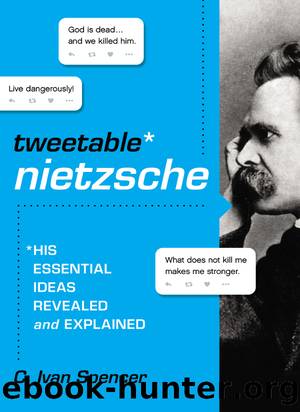
Author:C. Ivan Spencer [Spencer, C. Ivan]
Language: eng
Format: epub
Publisher: Zondervan
Published: 2016-09-02T00:00:00+00:00
Friedrich Nietzsche @TwilightOfIdols
Moment, a long, eternal lane leads backward: . . . Must not whatever can happen have happened, have been done, have passed by before?3
We’ve all experienced déjà vu, an ephemeral feeling that we have been somewhere or done something before, while our rational mind tells us we have not. Nietzsche held that every moment leads back to eternity, an endless succession of moments. In that unbroken chain of events, every sequence of events has already happened before. Envision time moving eternally in repeating patterns like a mesmerizing fractal image. All that occurs will recur, ad infinitum. In the history of ideas, two basic models of time appear in philosophies of history: the cyclical and the linear.
The cyclical view holds that time occurs in some cycle. This seems natural since the celestial bodies move in cycles. From ancient times people recognized cycles and recurring patterns in life and the world. More than seasons and celestial events, life itself followed a cycle of birth, reproduction, decay, and death. The other model of time follows a linear trajectory. Here time runs in a line, not in circles. The celestial bodies may move in cycles, but time itself occurs linearly. The so-called “arrow of time” flies in a line. Some people attached purpose, or teleology, to the trajectory. Time begins, moves in a direction, and then will end. We often hear this model assumed in statements about the end of time or history. These models of history form deep assumptions in our worldviews, and their undercurrents ebb and flow in our interpretations of events.
Nietzsche viewed his philosophy of history as a nuanced cyclical time that he called an eternal return or eternal recurrence. In the following tweets we will see the implications of his eternal return and how it integrates into other elements of his philosophy.
Download
This site does not store any files on its server. We only index and link to content provided by other sites. Please contact the content providers to delete copyright contents if any and email us, we'll remove relevant links or contents immediately.
| Anthropology | Archaeology |
| Philosophy | Politics & Government |
| Social Sciences | Sociology |
| Women's Studies |
The remains of the day by Kazuo Ishiguro(9016)
Tools of Titans by Timothy Ferriss(8418)
Giovanni's Room by James Baldwin(7362)
The Black Swan by Nassim Nicholas Taleb(7145)
Inner Engineering: A Yogi's Guide to Joy by Sadhguru(6805)
The Way of Zen by Alan W. Watts(6624)
The Power of Now: A Guide to Spiritual Enlightenment by Eckhart Tolle(5802)
Asking the Right Questions: A Guide to Critical Thinking by M. Neil Browne & Stuart M. Keeley(5789)
The Six Wives Of Henry VIII (WOMEN IN HISTORY) by Fraser Antonia(5523)
Astrophysics for People in a Hurry by Neil DeGrasse Tyson(5197)
Housekeeping by Marilynne Robinson(4462)
12 Rules for Life by Jordan B. Peterson(4316)
Ikigai by Héctor García & Francesc Miralles(4286)
Double Down (Diary of a Wimpy Kid Book 11) by Jeff Kinney(4284)
The Ethical Slut by Janet W. Hardy(4271)
Skin in the Game by Nassim Nicholas Taleb(4264)
The Art of Happiness by The Dalai Lama(4137)
Skin in the Game: Hidden Asymmetries in Daily Life by Nassim Nicholas Taleb(4019)
Walking by Henry David Thoreau(3973)
